

In this blog, we explore why hand gestures matter, the science behind them, how different gestures influence perception, real-life situations where gestures give you an advantage, and common myths that often mislead people.
Hand movements are one of the most expressive tools in human communication. They help us think, explain, emphasize, and connect. When used well, gestures make your message clearer and more memorable. When used poorly, they distract, confuse, or reduce credibility.
In this blog, we explore why hand gestures matter, the science behind them, how different gestures influence perception, real-life situations where gestures give you an advantage, and common myths that often mislead people.
Gestures do more than animate your speech—they enhance understanding. Research shows that people remember information twice as well when gestures accompany words.
Gestures help:
Your hands are visual storytellers.
There are three main categories of gestures:
Gestures that support what you’re saying.
Examples:
These help people visualize your message.
Gestures that manage conversation flow.
Examples:
These help guide interaction smoothly.
Unconscious gestures that reflect stress.
Examples:
Adaptors reveal emotional state more than intention.
Understanding these helps you interpret and refine communication.
They make you appear confident, clear, and grounded.
These suggest nervousness or lack of control.
Using gestures to count points, illustrate examples, and emphasize conclusions makes you more engaging.
Example:
Saying “three steps” while lifting three fingers improves recall.
Open-palm gestures create trust, making clients more receptive.
Pointing fingers, however, can create resistance.
Leaders who gesture with calm, intentional movements appear more confident and in control.
Gestures help break down complex ideas—use them to show cause and effect, flow, or structure.
Gesturing while telling a story makes you more expressive and magnetic.
People naturally gravitate toward animated, not robotic, communicators.
Hand movements can have different meanings across cultures.
Examples:
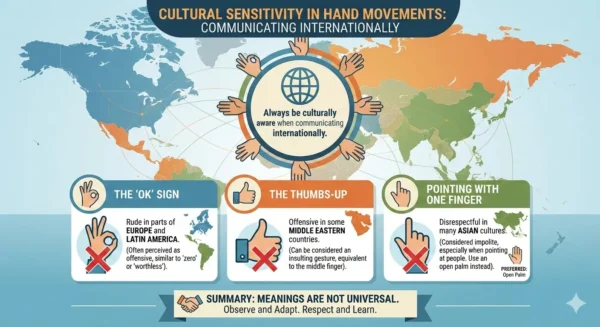
Always be culturally aware when communicating internationally.
False.
Natural hand movement is a sign of engagement and passion.
Stillness, ironically, can appear tense.
No.
Hiding hands signals discomfort or secrecy.
Visible hands increase trust.
Incorrect.
Pointing is perceived as rude, aggressive, or parental.
Use open palms instead.
Chest to waist level is the ideal zone.
Gesture naturally as you speak.
Record yourself to identify habits.
For example:
“First… second… third…” with finger counting.
Hand gestures are a powerful part of your communication toolkit. When used intentionally, they increase clarity, inspire trust, and make your message more impactful. Your hands can distract—or they can elevate your presence. The choice lies in awareness and control.


